

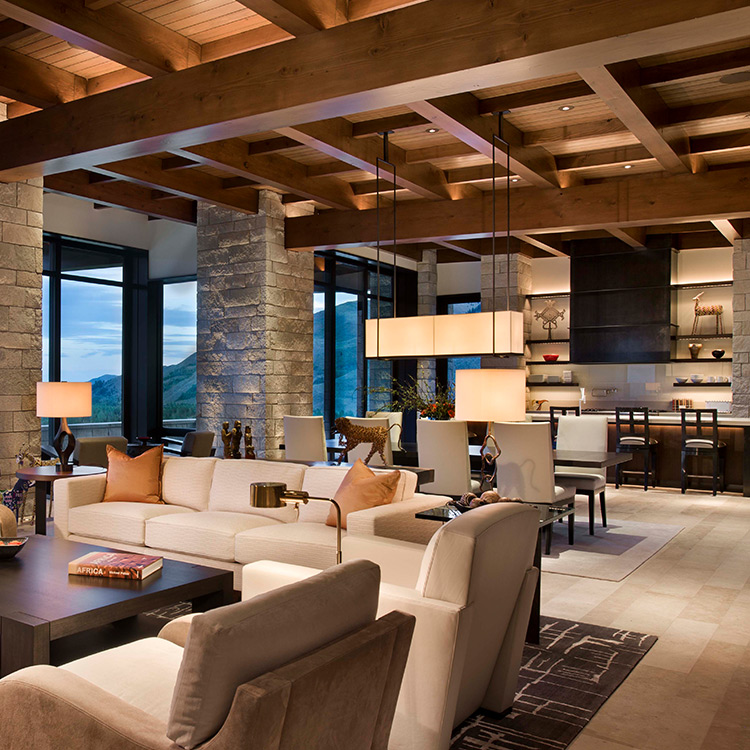
Lighting Cohesive Environments
Where living and dining converge, lighting becomes the connective tissue.
Through the Adaptive Method™, layered illumination responds to scale, texture, and use—balancing ambient glow, architectural emphasis, and intimate moments within a single, cohesive environment.
Every layer is intentional, allowing the design to transition effortlessly from day to evening, gathering to quiet.
Open-concept environments require a disciplined lighting strategy. Without clear hierarchy, large shared spaces can feel visually fragmented or uneven after dark. The goal is not to divide the room, but to define it — creating subtle boundaries through light while maintaining a seamless flow.
Within the ADAPTIVE framework — Architecture, Decorative, Art, Path, Task, Interior Design, View, and Exterior — multiple layers interact simultaneously in these spaces. Ambient lighting establishes continuity across the full footprint, ensuring comfort and visual balance. Architectural illumination highlights ceiling details or structural transitions, reinforcing the spatial rhythm. Decorative fixtures anchor key areas such as dining tables or seating arrangements, introducing focal points that organize the environment.
Task lighting is integrated discreetly, supporting functionality without disrupting the aesthetic narrative. Accent layers may highlight artwork, shelving, or material textures, adding depth without visual clutter.
The key lies in calibration. Intensity must be balanced so that the dining area feels intimate during meals while the adjacent living space remains welcoming and composed. Color temperature consistency ensures harmony throughout, preventing subtle tonal shifts that can unintentionally segment the room. Sightlines are studied carefully so that fixtures complement rather than compete across zones.
Control systems further unify the experience. Pre-programmed scenes allow the environment to evolve throughout the day — bright and energized for entertaining, softened for evening relaxation. Transitions occur gradually, maintaining continuity rather than abrupt change.
When lighting acts as connective tissue, the result is cohesion. Guests move naturally between spaces without perceiving boundaries. The architecture reads clearly. The environment feels deliberate and refined.
This is the discipline of layered illumination — not simply lighting rooms, but orchestrating how they function together.
If your home features open-concept living and dining areas, start the design dialogue with Adaptive Design Group to create a lighting strategy that brings the entire environment into harmony.